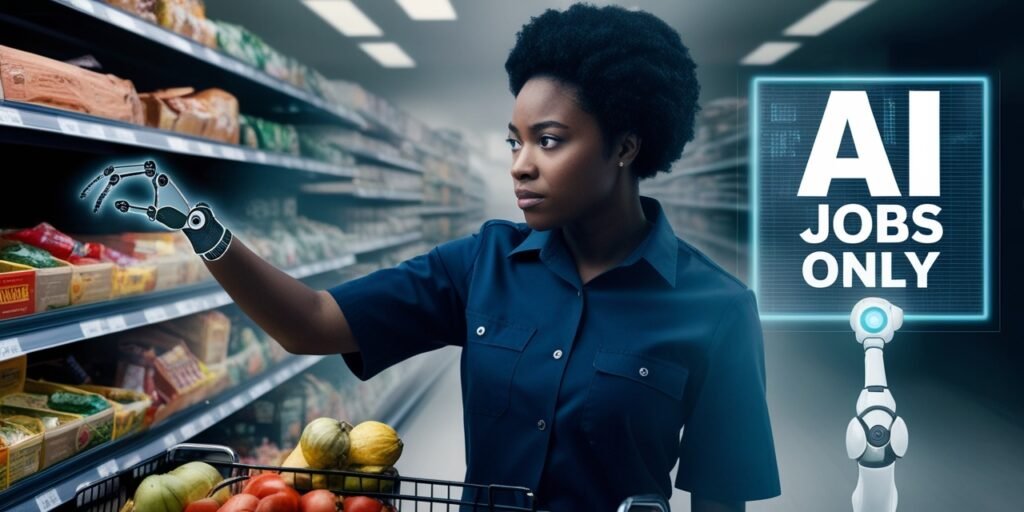
Some communities are more vulnerable than others — here’s what we need to talk about.
Let’s talk about what no one wants to hear —
AI isn’t just changing how we work. It’s deciding who gets to work.
The World Economic Forum says 92 million jobs could disappear by 2030 because of AI. That’s not a typo. Ninety-two million. But that’s not the whole story. The real concern? Who’s going to feel the loss the most.
Turns out, it’s not equal.
Not even close.
Why Certain Jobs—and People—Are in the Firing Line
AI tends to replace jobs that follow repetitive steps:
- Cashiers
- Admin assistants
- Caretakers
- Cleaners
- Ticket clerks
These jobs are often filled by Black, Latino, and low-income workers.
So when automation rolls in like a quiet bulldozer, these communities are the first in its path.
A McKinsey study showed that Black Americans are overrepresented in the very roles most likely to be automated. Latino workers in California? Same story, according to research by UCLA.
The Tech Jobs Are Booming—But Who’s Getting Them?
Here’s the wild part. While millions of jobs are expected to vanish, 170 million new ones are set to appear.
The catch?
Most of the new roles are in tech and AI—fields where these same communities are underrepresented.
Think about it.
We’re building the future of work, but locking the doors for the people who need it most.
Why?
It’s not because they’re not capable.
It’s about access:
- Not enough early exposure to STEM
- Few mentors who look like them
- Schools without resources
- Being subtly steered away from tech
- Feeling like they don’t belong
Ever heard of imposter syndrome? Imagine feeling like an outsider before you even get through the front door.
Why Diversity in AI Isn’t Just “Nice to Have”
This part really matters.
A lack of diversity in tech isn’t just unfair. It’s dangerous.
When the same type of people build AI tools, blind spots grow.
Ever heard of facial recognition systems struggling with darker skin tones? That’s not by accident—it’s by design. Or rather, lack of thoughtful design.
Hiring tools with algorithmic bias.
Voice assistants that don’t understand certain accents.
Systems that ignore real-world nuance because they were trained on narrow data.
Without diverse voices in the room, the tools we build won’t serve everyone.
So… What Now?
This isn’t about blaming AI.
AI’s not evil—it’s just a tool.
But how we use it, and who gets a say in shaping it, matters more than ever.
We need:
- Better education pipelines into tech
- Mentorship for underrepresented youth
- Bias training in AI development
- Real investment in diverse talent
Because if we’re not intentional, we’re not just letting 92 million jobs disappear.
We’re letting inequality grow wider—on autopilot.
Final Thought
Technology should bring us closer, not leave millions behind.
Let’s make sure the future of work works for everyone. Not just the few who get a head start.